Additional assets and source files are available in the GitHub repository.
Approved boilerplate.
Use the following text when describing Wombat in articles, podcasts, or presentations.
Short (1 sentence)
Wombat (formerly known as WAF++) is an open-source, vendor-neutral framework for assessing and improving the quality of cloud workloads across 8 pillars: Security, Reliability, Performance Efficiency, Cost Optimisation, Operational Excellence, Sustainability, Sovereign, and Agentic.
Social / short-form (≤ 280 chars)
Wombat is an open-source, vendor-neutral framework for cloud architecture quality — 8 pillars, transparent scoring, community-governed via public RFCs. Docs under CC BY 4.0, code under Apache 2.0. www.wombat-gov.dev
Standard (2–3 sentences)
Wombat is an open-source, community-driven framework for assessing and improving cloud workload quality. It covers 8 pillars — Security, Reliability, Performance Efficiency, Cost Optimisation, Operational Excellence, Sustainability, Sovereign, and Agentic — with a transparent scoring model called PASS.
Unlike proprietary vendor frameworks, Wombat is governed openly via RFCs in GitHub Discussions, making every decision traceable and every control citable. The framework is free to use, contribute to, and build upon.
Podcast / interview intro
Wombat is an open-source framework that gives engineering and architecture teams a vendor-neutral lens for evaluating cloud workloads. It organises everything across eight pillars: Security, Reliability, Performance Efficiency, Cost Optimisation, Operational Excellence, Sustainability, Sovereign, and Agentic.
What makes Wombat different is how it's built: every guideline, scoring rule, and design decision goes through a public RFC process on GitHub — fully transparent, fully community-driven. There's no vendor behind it, no upsell, and no black box. Anyone can read the criteria, challenge them, and improve them.
Media mentions.
Articles and references about Wombat from the press and media community.
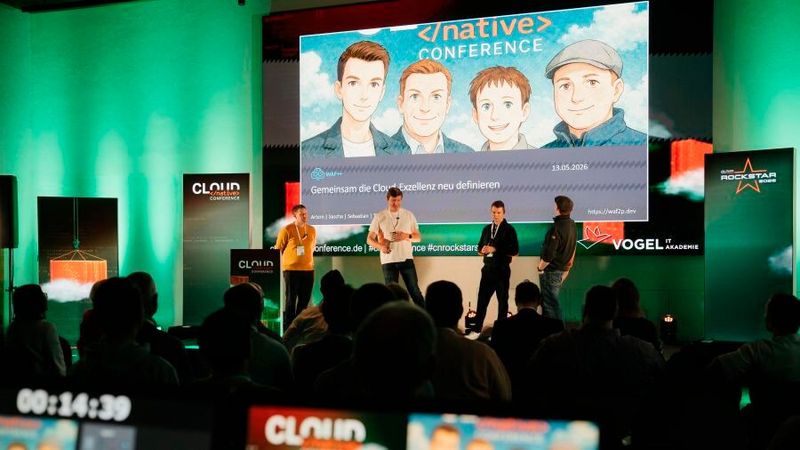
Cloud Native Conference 2026
CloudComputing Insider · 28 April 2026 · by Paula Breukel
"Cloud-agnostic under the name 'Wombat' is emerging. Cloud-agnostic means here that the guidelines do not bind to individual hyperscalers, but remain compatible with multi-cloud and hybrid setups."
Datacenter Insider · 03 June 2026 · by Paula Breukel
"Das Community-basierte Open-Source-Framework Wombat wurde erstmals auf der Cloud Native Conference 2026 in Frankfurt vorgestellt. Entwickelt von Sascha Lewandowski, Artem Lajko, Tim Urlaub und Sebastian Meyer, soll das Framework Architekturbewertungen über Cloud-Grenzen hinweg vereinheitlichen und Multicloud- sowie Hybrid-Cloud-Strategien unterstützen."
We use cookies to keep the site working and, with your consent, to understand how visitors use it. You can change your choices at any time via the floating cookie button.